Druga gostja pete sezone Vodenja s posluhom je Jana Petek, nekdanja generalna direktorica Novartisa v Sloveniji, ki že vrsto let zaseda pomembne vodstvene funkcije v farmacevtski industriji. Osrednja tema je vodenje sprememb in izkušnje, ki jih je dobila ob vodenju oddelitve Leka in Novartisa. Jana Petek slikovito pravi: “Avion je bil že v zraku, mi smo ga pa še vedno gradili.”
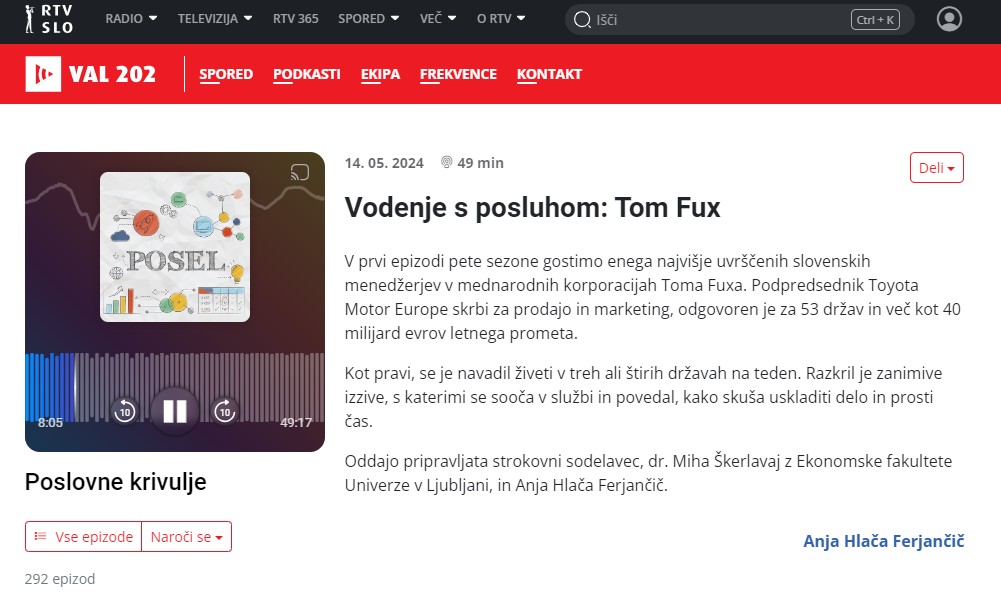
Začenja se peta sezona podcasta Vodenje s posluhom na Valu 202. Tokrat z gospodom Tomom Fuxom, enim najvišje rangiranih Slovencev v mednarodnih korporacijah. Kot podpredsednik Toyota Motor Europe skrbi za prodajo in marketing, odgovoren je za 2000 sodelavcev iz 53 držav in več kot 40 milijard evrov letnega prometa. Kot pravi, se je navadil živeti v treh ali štirih državah na teden. Razkril je zanimive izzive, s katerimi se sooča v službi, o stalnih izboljšavah, kaizenu, psihološkem lastništvu, sistemu stalnih sprememb in karierne rasti ter razvoja. In še veliko več, tudi o organizacijski kulturi, kjer je spoštovanje središčna vrednota, radovednost pa ena ključnih točk poslovne in vodstvene filozofije. “Naša kultura je stara več kot sto let, vendar se vedno znova dopolnjuje”, pravi.
Under the auspices of alumni of Stellenbosch Business School (South Africa), and the School of Economics and Business at the University of Ljubljana (Slovenia), I have utterly enjoyed the webinar with prof. dr. Andre Roux and dr. Olusiji Aina on Post-heroic leadership: The future perspective. We discussed the business landscape, the zeitgeist, and the overall climate for the next generation of post-heroic leaders, in addition to the leadership strategies to address the impending wicked problems and policrisis. We were honored by the attention we received from participants from more than 16 countries on three continents. If you missed the event, you are welcome to take a look at the webinar recording.
Peto leto soustvarjanja, štiri sezone z zanimivimi gosti, izjemna sovoditeljica Anja Hlača Ferjančič – vse to je radijska oddaja na Valu 202 Vodenje s posluhom. V zadnjih štirih podcastih lahko prisluhnete naslednjim gostom:
Luka Renko, inženir, vodja, investitor in koordinator Sledilnika o vodenju kot profesiji namesto vodenja ‘za zraven’, o dozorevanju kot vodja, o vodenju profesionalcev in prostovoljcev in še marsičem zanimivem: https://val202.rtvslo.si/podkast/poslovne-krivulje/215/175019404
Medeja Lončar, predsednica uprave in direktorica Siemensa v Sloveniji, Srbiji in na Hrvaškem o svoji bogati vodstveni poti in potrebi po razumevanju duha časa in sistemov, v katerih vodje delujejo: https://val202.rtvslo.si/podkast/poslovne-krivulje/215/175032657
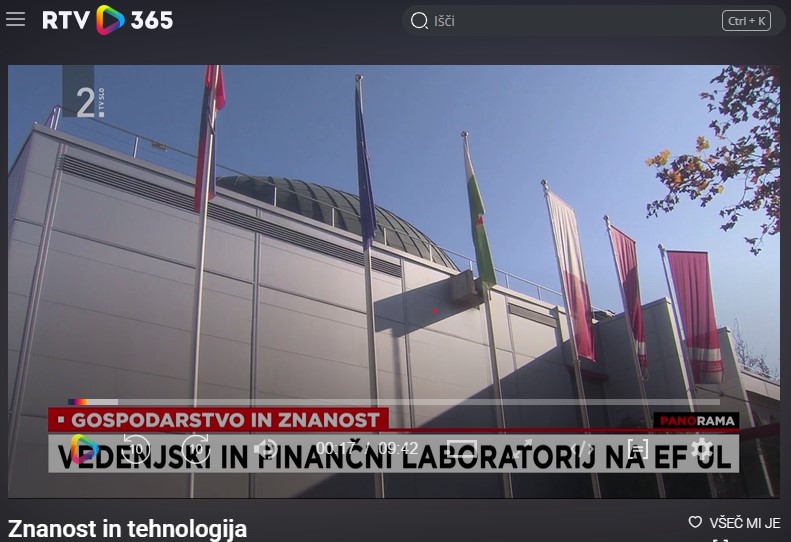
Vabljeni k ogledu televizijske oddaje Znanost in tehnologija (12. 10. 2023), kjer smo predstavili dve novi raziskovalni pridobitvi na Ekonomski fakulteti Univerze v Ljubljani – Vedenjski in Finančni laboratorij.
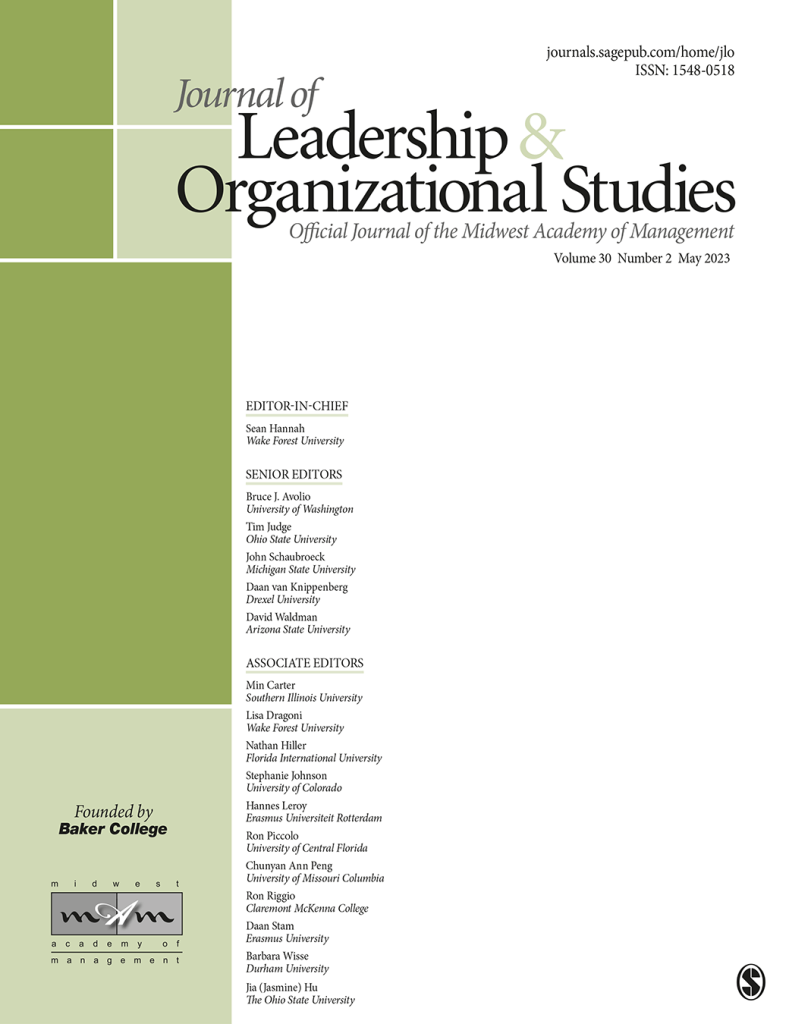
Welcome to read our recent paper on sparing employee creativity. Creativity is a critical determinant of organizations’ abilities to compete and perform in rapidly changing and complex contexts. Though scholars have identified several contextual factors, such as leadership, that motivate employees’ creative performance, the psychological mechanisms and boundary conditions underpinning this relationship are relatively unknown. Drawing on social exchange theory, we propose that a proactive orientation, a psychological state rooted in the cognitive and behavioral process of setting a proactive goal and striving to achieve it, is a critical mechanism linking authentic leadership to employees’ creativity. Across two field studies of working professionals in Central Europe and the U.S., we show how authentic leadership fuels employees’ creative performance through a proactive orientation and introduce leader–member exchange (LMX) as an important moderator of this mediated relationship. In Study 1, using a sample of European manufacturing employees, we find support for the mediating role of a proactive orientation linking authentic leadership to creative performance, above, and beyond the effects of ethical leadership. In Study 2, using a sample of university staff, we replicate this finding and extend it by highlighting the moderating role of LMX on the authentic leadership-proactive orientation relationship.
A decade since the seminal paper on knowledge hiding in organizations (Connelly et al., 2012) emerged, this research area has witnessed rapid evolution, resulting in a fragmentation of the field and conceptual proliferation. Given the increasing interest in knowledge hiding, I am happy to share the study that complements a set of recently published (systematic) literature reviews and proposes an organizing framework (nomological network) for antecedents and consequences of knowledge hiding, and tests it using meta-analytic procedures. Based on an effect analysis drawn from 131 studies and 147 samples, comprising 47,348 participants, the relationships between knowledge hiding and different antecedent and consequence categories are examined. The results generally support expected relationships across the vast majority of categories of knowledge-hiding antecedents, including job characteristics, leadership, attitudes and motivations, working context, personality, and individual differences. Knowledge hiding is related to outcomes, including creativity, task performance, incivility, deviance, and deterioration of workplace behavior. We also provide comprehensive empirical evidence to support the conceptual claim that knowledge hiding is not correlated with knowledge sharing. We have also tested mediations of the most salient antecedents of knowledge hiding. Through our meta-analytic review, we hope to solidify and redirect the trajectory of the growing and maturing knowledge-hiding domain after its first decade of existence.
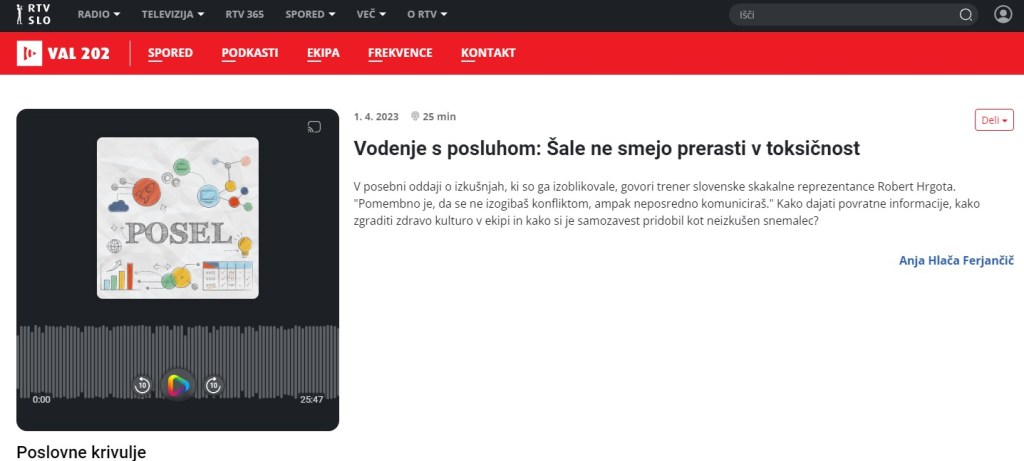
Sezona za slovenske smučarske skakalce je zaključena in to izjemno uspešno. Kdo so ljudje v ozadju tega kontinuiranega uspeha? Kako voditi zvezde in iz njih oblikovati tim srčnih ljudi? O tem in še marsičem, sva se z Anjo Hlača Ferjančič na Valu 202 pogovarjala s trenerjem slovenske reprezentance Robertom Hrgoto. Naša korespondenca se začne nekako takole “Kje pa sta mene našla?“. Beri, “ kaj lahko jaz povem o vodenju? “ – Veliko, zelo veliko! Recimo: “Ni problem, če te drugi hvalijo. Problem je, če to začneš verjeti sam.” ali pa o tem, kako ga je izkušnja prejetega zaupanja pripravila tudi za vlogo vodje, ki je to postal skozi krizno situacijo.
Welcome to read the article about leaders’ idea championing and followers readiness to change, just published in Journal of Change Management by dr. Antonio Sadarić and myself.
Change agents influence employee attitudes in order for organizations to change. In an effort to unravel this influence mechanism, we examined the change leader-recipient relationship. More specifically, how change leaders’ championing (independent variable) relates to recipients’ readiness to change (dependent variable). Our conceptual model of change leaders’ prosocial sensegiving is based on adult attachment theory operationalized through storytelling. To test our model, we surveyed 164 change recipients undergoing organizational change in various industries. Results confirm the first part of our model: psychological need satisfaction partially mediates the relation between change leaders’ championing and recipients’ readiness to change. In other words, prosocial change leaders act as attachment figures alleviating anxiety caused by ambiguity addressing change recipients’ proximity-seeking behaviour. Despite what has been described in scholarly works, change leaders’ methods of persuasion seem to be a more accurate indicator of recipients’ readiness for change. Part two of our hypothesized model could not be confirmed: moderation effects of leader influence and narrative intelligence could not be confirmed. We conclude that prosocial change leaders’ who demonstrate narrative intelligence use stories to elicit an emotional response from change recipients, effectively increasing their perceived psychological need satisfaction, ultimately affecting their readiness to change.
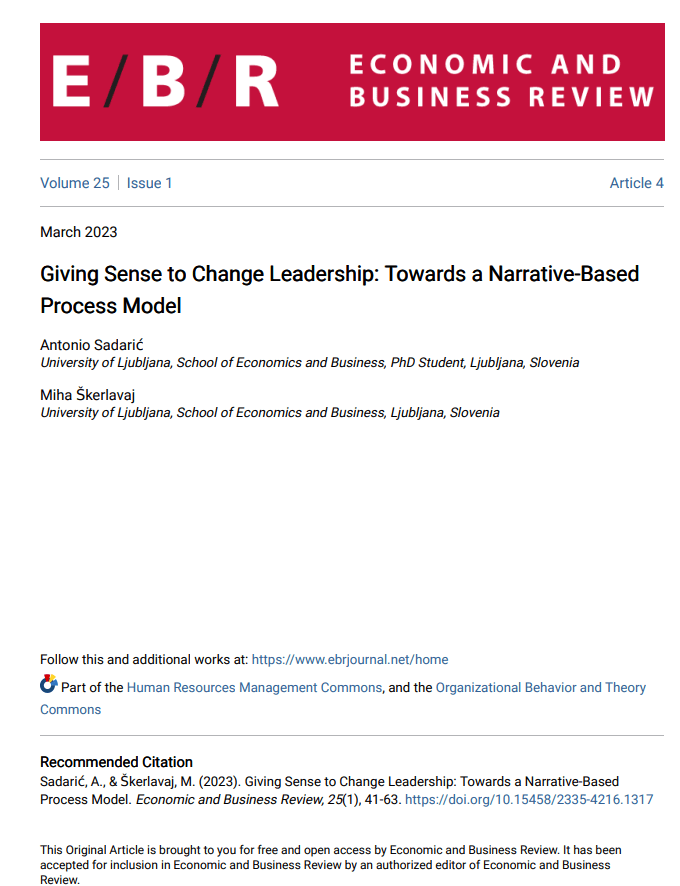
Welcome to read the paper dr. Antonio Sadarić and myself wrote about sensemaking and change leadership. Recent studies on change agency and organizational change failure have signicantly broadened the organizational behavior perspective on individual change experiences, however, the underlying mechanism for change leaders’ infuential behavior remains a relatively underspecied area. Our central theoretical contribution focuses on the ways in which linking the finndings from different research areas that deal with storytelling and persuasive communication can contribute to understanding the underlying mechanism of change leaders’ influential behavior. We examine the various strands of research in management concerned with change leadership and persuasive communication, and propose a multidisciplinary perspective from a variety of perspectives. Our approach draws on the key theoretical perspectives from the social cognitive theory and commensurable interdisciplinary findings as the basis for a narrative-based process model of change leaders’ in uential behavior. Our model includes propositions about the change leader’s interpretation of ideological change as well as the change leader’s process of sensemaking and sensegiving. We argue that the change leader’s persuasive communication efforts are based on the leader’s narrative intelligence and in uence, which promote the change recipient’s attachment formation.
Keywords: Change leadership, Persuasive communication, Narrative-based process model, Social cognitive theory



 prof. dr. Miha Škerlavaj
You must be logged in to post a comment.